Showing posts with label activity. Show all posts

Thursday, 11 December 2014

Teaching inferential reading


Simple comprehension of a text isn’t enough. To be high-level readers, children need to be able to infer meaning that goes beyond what the text explicitly tells them. But how can we teach them to do this?


In this blog post, you'll find an outline for a session on inferential reading for use with Key Stages 2 and 3. There's also a free worksheet for you to download from our website and a number of suggested starter activities. 

But first, what is inferential reading, and why is it so important?


An essential reading skill
Inferences are the conclusions we draw based on what we already know and judgements we make based on given information. When reading inferentially, students use the information the text provides, combined with prior knowledge, to make assumptions about meanings which are not directly stated.

In a blog post on inferential reading for P@WS, Leanne Hegarty says: 'Inference can be as simple as associating the pronoun "he" with a previously mentioned male person. Or, it can be as complex as understanding a subtle implicit message, conveyed through the choice of particular vocabulary by the writer and drawing on the reader’s own background knowledge.'

The ability to make inferences is important for reading comprehension, but also more widely when analysing and critiquing texts. Inferential reading is vital to understanding the aims of a writer and the impact of their work on its audience, which, in turn, are crucial to the study of literature – at GSCE and beyond.

How to teach inferential reading
So we've established the importance of inferential reading – but how do we teach it?

It's best to start early, in Key Stages 2 and 3. A session on inferential reading with pupils of that age group might progress as follows:

1. Introduce the notion of making inferences from text. You can do this through an example text or poem (such this one here); a brief, sentence level activity (such as ‘Cucumber Cues’ or ‘Simple Sentences’ – see 'Activities to introduce inferential reading' below); or a discussion on the inferences students make in everyday life.

2. Hand out the text or section of the text you will be working on. Give each student the activity sheet ‘Reading and discussing texts together’ - download this for free here (download begins straight away).

Before reading the text:
3. Encourage students to discuss their prior knowledge about the topic. They will need to think about their experiences, background knowledge, what they have heard and seen, and other books they have read, then record their ideas in box 1 on the worksheet.

4. Students make predictions about what they might learn from the text or what might happen in the text, filling these in box 2.

5. Students record any questions they have about the text in box 3.

Reading the text:
6. Ask students to read the passage as a whole without interruption.

After reading the text:
7. Have students review their written predictions about the text.

8. Ask students whether they needed to modify their ideas in light of the text, and how the new information changed or reshaped their prior knowledge. They write this down in box 4.

9. Students complete the activity with a summary of the text in box 5, filling in the most important facts from the text in chronological order.


Activities to introduce inferential reading

There are many fun and simple games and activities to introduce the concept of inferential reading. You can find a whole list of them in this article by Dale Pennell. One example of his is the game ‘Cucumber cues’. This is how you play it:

1. Write a list of sentences on the board. Replace one word in every sentence with the word ‘cucumber’. Examples include:

  • I like to eat peanut cucumber.
  • A dog has four cucumbers.
  • I clean my cucumber with a toothbrush.

2. Students work individually or in pairs to write out the sentences, changing cucumber to a word that makes better sense.

3. Students share their responses with the class and identify words that gave them clues to the word they substituted. Ask students to relate the clue word to their background experiences and explain how this background information helped them find an appropriate substitute word.

An alternative to this activity is ‘Simple sentences’. Give students a list of sentences to practise making inferences. Each sentence should contain two facts, which, when combined with prior knowledge and context, can give the students further information about the characters or situation in the sentence. Examples include:

  • Sue blew out the candles and opened her presents.
  • John went running out into the street without looking.
  • We bought tickets and some popcorn.

Roy van den Brink-Budgen explores ways teachers can develop the critical skill of inferential reading and the research behind it in our upcoming issue of Creative Teaching and Learning. Watch this space for more information!

Thursday, 23 October 2014

Shot at dawn - A free activity for Remembrance Day


Image: Tinelot Wittermans
Many schools will be doing something special this year for Remembrance day - are you? This free activity is designed to honour the men who fought and died for our country, while also engaging students in a deep moral, historical and political debate.

In 2006, the British Defence Secretary, Des Browne, pardoned the soldiers who were executed for cowardice during World War I. The service of these men is now free to be honoured on Remembrance Day along with the many others who died during the fighting.

There are arguments for and against pardoning these men, and the complex and thorny issues surrounding the topic provide a useful opportunity for students to develop their debating skills and to practice writing to persuade/argue.

In this free activity, students use the text provided and their own research to write an argument either for or against pardoning the men who were executed for cowardice during WW1. The activity could also function as a letter-writing exercise, a class debate or a philosophical enquiry using the included text as a stimulus.

Older pupils may well be the same age as some of the executed soldiers, who, at only 15 or 16, lied about their age to join the army. This, along with wide-spread media focus on Remembrance Day, will make for a relevant and thought-provoking discussion.

You can download the activity resource pack for free here. It includes instructions for implementation and also the stimulus text.

This free activity is taken from our cross-curricular project plan, The Great War. You can purchase the rest of this project for £36.

Activities include:
  • Plotting the path to war, examining each country's motives for joining in detail
  • Identifying the purpose of propaganda and creating a propaganda poster
  • Writing a poem about a gas attack in the trenches
  • Investigating the impact of the armistice on Germany and the rest of Europe
...And much more!

See here for a full description of the project and its included activities and resources.

Wednesday, 17 September 2014

Can maths really be creative?


Image: schoolatoz.nsw.edu.au

Carey Ann Dodah of Explore Learning thinks it can. In this week's guest post, she considers a few simple ways to promote the development of problem-solving skills and creativity in maths lessons, as expected by the new primary maths curriculum.


'Creativity in Maths!? Isn’t that an oxymoron?' was the response from many when we launched our creative maths programme last year, a weekly class for eight- to ten-year-olds. However, we are strong believers that creativity defined as ‘a process where something new and valuable is created’ is the very essence of maths and it’s those inquisitive mathematical minds that we want to develop in our future generations.

The new National Curriculum supports this - problem solving is implicit across all subjects in the maths Programme of Study and with the recent announcement from the government that from 2016, Key Stage 1 and 2 tests will now include more problem solving, we can see the emphasis being placed on this skill.

We love solving problems at Explore Learning – it’s a life skill that we want every child to enjoy and have the confidence to tackle, not just in our centres but in their school experience. However, first there are some hurdles to overcome.

What makes a good maths problem?
In classrooms, problem solving is typically taught in a formulaic manner. The problem is introduced, a technique is demonstrated, the process is practised and then used to apply to other scenarios until practice makes perfect. In life though, and in maths, there is not always a technique or set route to follow to reach a solution and remember if you know how to solve something then it isn’t really a ‘problem’. A problem has to be new and without an obvious route to solution to genuinely challenge us. In maths, as in life, we need to develop children’s confidence to find a route themselves. They own the problem and they can fix it. 

At Explore, we have been very fortunate to work with NRICH – a team of inspiring mathematicians, teachers and trainers based at the University of Cambridge. Together we have created the annual National Young Mathematicians Award competition. Its goal is to bring rich, creative problem solving into primary schools. Last year,1000 schools took part, entering a team of their top four mathematicians (typically two girls and two boys).

Unlike conventional maths competitions that are based on individuals attempting paper-based tests involving equations, computations and problem solving, the National Young Mathematicians Award allows young people to create maths. The problems are real, they are without an obvious solution, and they often involve making something. They provide opportunities for logical thinking, identifying patterns, looking for all possible solutions, hypothesising and perhaps most importantly communicating and working as a team. 


Image: getsurrey.co.uk
I am always inspired observing the final each year. I especially love seeing the children working together. It highlights that maths is not a solitary subject – its true power is seen in collaboration. All the tasks that children get involved with require collaboration and therefore good teamwork is essential. The tasks are also very open ended with limited instructions so the next ingredients to success are using logical thinking, working systematically, using trial and improvement and taking ownership of a problem. You can really tell the schools that have incorporated this type of problem solving into their lessons previously. Those children that haven’t find it very difficult to know how to start given so open parameters – so much freedom!

How can we teach problem solving?
So how can schools introduce these skills into existing maths teaching? How can we make maths more creative today? First, let’s adopt one important rule – maths is about more than a right answer. It’s about exploration and letting your imagination go!

Try this exercise to demonstrate the concept to students and colleagues. Ask for three volunteers and instruct them to tell you a two-digit number, it doesn’t matter which ones they give. Get students into pairs and ask ‘which is the odd one out?’. On the board, draw five bullet points. 

Let’s say you have been given 62, 27, 36. Give a couple of minutes to the group and ask each pair to tell you their ‘answer’ and the reasons why. Record all the reasons on the board and try to fill the five bullet points. 

You may have something like this:
• 27 – it’s an odd number
• 62 – it’s above 50
• 62 – not a factor of 9
• 27 – it’s below 30
• 62 – ones are smaller than the tens

These are all correct answers! Well done! 

Now add several more bullet points to the board and allow the group much longer this time to think up some other possibilities. Thinking time in maths is vital – if cut short then you are unable to uncover the rich, deep thinking that everyone is capable of. Too often this is missed because time is pressured.

Now you will have less obvious associations made:
• 27 – has a diagonal in the digit
• 62 – adding the two digits together does not equal nine
• 36 – square number
• 27 – the words have a different number of syllables to the other two
• 27 – has ‘open’ figures rather than ‘closed’ ones

And you can keep going and challenging your group to think of more reasons. It can be anything as long as they can explain it! You’ll be amazed at the amount of learning that can be gained from such a simple task and how many different directions this will lead your learners. Those without the confidence to share initially might suddenly find a gem. 

Your role is as a facilitator: little talking, lots of listening and then jumping on the great ideas that could pull out more maths from the activity (‘what is a square number? Can you think of any others?’) and in doing so help children clarify their ideas and share their knowledge.

This exercise demonstrates the power of peer learning. It tells students that you value different ideas, strategies and routes. It encourages clarity in explanation and opens opportunities to introduce new vocabulary in a subtle but powerful way. Last but not least it encourages creative, imaginative thinking.

Making maths accessible
Image: willowbrook.leicester.sch.uk
The task described above is a good example of the kind of activities that we cover with our children each week on in creative maths course.  Every week our centres fill with a group of excited mathematicians awaiting a new challenge. They are not all ‘strong’ mathematicians, in fact many of them lack confidence in class but this is maths with a difference!

All the activities apply the NRICH philosophy of ‘low threshold, high ceiling’. In essence, low threshold means that all the exercises are accessible to the whole group. To access the task, you may need a basic ability to add numbers or use a ruler – everyone can have a go. High ceiling refers to the task having the potential to result in very complex mathematics, nth terms and formulas, should the individual be able. 

One of our favourite examples in the creative maths course is buttons! This is an exercise that could run over a couple of classes.

To begin with, describe that you have a cardigan with three buttons. You like to do the cardigan up in different ways every day. Sometimes you might start at the top, sometimes from somewhere else. How many different possible ways can you do up the buttons on the cardigan? This can be a great practical task and you could have a pot of different coloured buttons that the children could use or they might prefer to use T M B (top middle and bottom). It’s about the children finding a method that makes sense to them, rather than the way you would do it. 

Quite quickly children will come back with answers – it’s great to ask at this point that you need to be convinced that they have found all the different ways. Once children have convinced you, ask if they can find out what happens when you have four, five or six buttons and the task becomes a greater challenge. Your able mathematicians may start identifying a pattern and they might use conjecture and develop a theory. They are reaching for a high ceiling but in gentle, structured steps that allow you to see them grow (intellectually and in confidence) within a matter of hours.

You can find more similar problem solving activity ideas here and here.

What other skills will creative maths develop?
This practical maths allows children to improve key mathematical skills which also translate into other subject areas such as science, technology and are used in later life: 
  • logical thinking 
  • developing a systematic approach 
  • trial and improvement strategy 
  • exploration and explanation skills 
  • convincing and proving 
  • collaborative learning.

The challenge was to prove that maths can be creative, collaborative and stimulating. I hope this post has given you some insight into how this can be the case and some inspiration to challenge your young students. Perhaps you can try some of these rich, low threshold–high ceiling exercises out before entering a team for the National Young Mathematicians Award this autumn. Let’s see how far they can go!

Carey Ann Dodah is Head of Curriculum at Explore Learning.

To enter a team into the National Young Mathematicians Award, visit www.explorelearning.co.uk/youngmathematicians. Registration closes 30th September so hurry!

For further activities to help students practise for the competition, visit nrich.maths.org. For more information on Explore Learning, visit www.explorelearning.co.uk. 


Image: explorelearning.co.uk

Monday, 15 September 2014

Activities for outdoor learning this Autumn


Image: gardeningforkids.com.au

Earlier this year, we published a blog post detailing some lovely outdoor activities to enjoy with your students in the Spring time. But, in case you haven't noticed, it's no longer Spring! Autumn is upon us and with it brings plenty of opportunities to get your class out in the crisp golden sunshine and kicking about in the leaves.


The resource sheets, activity ideas and online flash games featured below are all available from The Woodland Trust's fabulous Nature Detectives website. They're all completely free so we figured they wouldn't mind us sharing some of their wonderful ideas and resources with our readers! Simply follow the links to download. And don't forget that this is just a sample. We really recommend checking out their site for more Autumn activities and ideas.

ID tools and spotter sheets
Some brilliant resources here! Get your class outside and identifying Autumn leaves, fruits and seeds, twigs and more. My personal favourite resource is the hunt for animal tracks, as well as - one for the boys this one - an animal poo ID sheet! (It does stress to kids that they shouldn't touch the animal droppings). Other spotter sheets include nocturnal animals, minibeasts, birds, bramble and fungi. If you don't have access to a proper woodland in school, why not send some spotter sheets home as homework (optional or otherwise)?


Image: Rake's School, West Sussex

Conkers
The best part of Autumn in my humble opinion... hunting for conkers! Nature Detectives provides instructions on how to play conkers, plus a snazzy conker champion certificate and a cool horse chestnut tree fact sheet. There's also a recipe for making realistic-looking conkers out of chocolate (no actual cooking required - all you need is a fridge) which would be great for a classroom session on cooking and nutrition.

Den building
Giving conkers a run for their money as most awesome Autumn activity, is this lovely set of tips for building a woodland den. It's aimed directly at the kids so it's all in really simple language with loads of great ideas plus helpful safety advice.

Tree faces
Image: naturedetectives.org.uk
A brilliant resource for art lessons this, students find and draw a picture/photograph a 'face' on a tree. It's a great way to develop imagination and also empathy, as the kids are encouraged to think about how the tree is feeling based on the face it's pulling. Could you take it one step further and have them come up with reasons why the tree is feeling that way? What happened in the woodlands that day? The children could write up their stories as a follow up activity or even look at existing stories about tree people, such as the green man or dryads from Greek mythology. Don't miss the tree face 'hall of fame' on the page linked above - your students could even send in their own 'tree face' photos like the one to the right.

Cross curricular indoor activities and online games
You don't even need to go outside to enjoy all Autumn has to offer in every subject across the curriculum! 

Science
Develop a range of scientific skills with this DIY fungus experiment in which kids control variables like temperature, moisture and light to work out what fungi need to grow best. Another science activity is the food chains game, a board game which teaches children the connections between woodland wildlife in a fun, imaginative way. 

Literacy
If you'd prefer to develop your class' literacy skills, why not try the concrete poetry online flash game. Kids choose a woodland shape (or draw their own) and fill it with words (either from pre-prepared word banks or their own imaginations) to make a poem. The completed poems can be printed out. 

Another literacy game on the Nature Detectives site is called Save our wood. This presents players with plans to build a road through beautiful Badger Wood. The player navigates the woodland, looking for woodland residents. They interview each creature, collecting information before designing and writing an article to defend the wood from development. There's also a list of supporting resources including a sheet to help them develop a balanced debate (with arguments both for and against), plus a template to help them format an offline newspaper piece too. 

History
Another fab online game worth mentioning, this one based around developing historical knowledge, is A tree's memory. In this game, kids meet three trees - the ancient tree, the city tree and the country tree. They pick a tree and fill in its life story from a choice of images. For example, the city tree is only 50 years old, but in 1969, it witnessed something that was 'out of this world'! After selecting the correct image, the player gets a bit more information on the event, plus the tree's opinion!


Image: Rake School, West Sussex
Are you thinking of taking your class outside? Fancy a bit more inspiration or some advice on assessing the risks? This article by The Woodland Trust's Amy Williams is packed full of safety advice and inventive ways to engage students with the natural world.

Alterntatively, if you'd prefer to read about other schools who've taken the plunge and rented a piece of woodland to care for and use with their students (and that's not as outrageous an idea as you might think), take a look at this article by Patricia Ockenden of woodlands.co.uk. In it, she describes the amazing curricular opportunities taking the classroom to the woods offers.

Monday, 30 June 2014

7 strategies for effective group work


In order to ensure excellent learning, teachers need to support their students in developing the skills that they need to work effectively with one another – ‘Work together’ is one of the 16 Habits of Mind of the most successful people! 


You may have heard of Dr Spencer Kagan’s collaborative learning structures. These are a range of approaches to group work that develop students' independent and collaborative learning skills - and make group work worth your while!

In a recent issue of Creative Teaching and Learning, Paul Fleming of Sedgefield Community College (a secondary school in Durham) shared with us his school’s adaptation of Kagan’s work, combining it with ideas from Paul Ginnis’ Teacher’s Toolkit to select 7 group work strategies to use across the whole school. 

Each of their chosen strategies was designed to support learning in a specific way. 

Perhaps you could spice up your group work with some of the strategies outlined below!


Strategy

Icon

Purpose

What it involves

One Stray

To support the creation of new groups A strategy that involves students discussing an issue in groups. At the end of a specified period of time, we would then ask one student to ‘stray’ from their original group and move to work with a new group in the class.
Round Robin

To support the development of ideas across groups Students work on their own answer initially working in a small group. After a specified period of time, the work would move to the next group and the new group would continue with the answer now in front of them.
Jobs For All

To support effective discussion through consistent roles Students are discussing an issue in groups, but each student has a specific role. For example, one will be the chairperson, one the scribe, one the spokesperson, etc
Talking Chips

To encourage students to think about all contributions All students in a group will have a set number of chips/tokens. In order to speak in a discussion, students need to spend one of their talking chips to get permission to contribute.
Ranking Exercise

To encourage students to negotiate to come to an agreement These tasks all involve students working in groups to take a series of ideas and rank them in order of importance, relevance, etc.
Playing Cards

To encourage group discussions through a series of games A series of strategies that involve students working in small groups answering questions on quiz cards or organising cards into different sequences, order, etc.
Show Down

To initiate peer assessment of learning All students in a group will complete a task individually. When the teacher calls ‘Showdown’, each student will share their response with the others in their group who will then decide which is their favourite response.

Use these consistently across the curriculum and your students will soon be experts - eager to share and show off their ideas! Not only that, but they will be developing many of the key Habits of Mind, such as the ability to work together, communicate clearly and listen and understand.

This blog post is based on the article, 'Strategies for thinking' by Paul Fleming in vol. 4.1 of Creative Teaching and Learning magazine. It's a fab piece, packed full of practical ways to turn your school into a Thinking School. Read it here!

Friday, 20 June 2014

Can you picture the music?


Philip Davis uses images and sound to make sure the students he works with can never say they haven't got any ideas. 

Here, he recounts some of the exciting projects he's undertaken with schools in the last couple of years, and shares a practical activity for you to try with your own students!

The ‘Whole New World’ project in Netherfield school, Nottingham, aimed to raise achievement and motivation in communication and literacy skills across the school. 


Every class, from Reception to Year Six, formed part of an imaginary land – oceans, caves, grassland, forests, rivers, lakes and mountains. I used sounds and images to immerse the pupils into their worlds – for example, a bubble machine and the sounds of waves and water were used with Reception.

Once the pupils had decided what their part of the land was like, they all developed a character. Their characters then became part of stories, and the students used their own images and others with sounds on the map templates. 

A Sherwood oak sculpture at
Netherfield School
As well as developing stories, we made books and models of the characters – Year Six even gave them Latin names. Each year group voted one character to represent their part of the land. These were then made into amazing sculptures using Sherwood oak. They are now in the playground as inspiration for more storytelling and poetry. Structures representing the areas of the land were also built around the playground and the pupils took an active role in doing this. 

Another interesting project I have undertaken with many schools is called ‘Element’, a week-long project based on the four elements – fire, water, earth and air.

The starting point of the whole week is poetry. I put together a collection of images and sounds to inspire ideas. Each pupil writes a poem based on what they experience from those images and sounds. I then collect all the poems and combine individual lines to create four songs – one for each element. Each class learns their song and the enthusiasm shown is wonderful when they realise it is their words being used with the music.

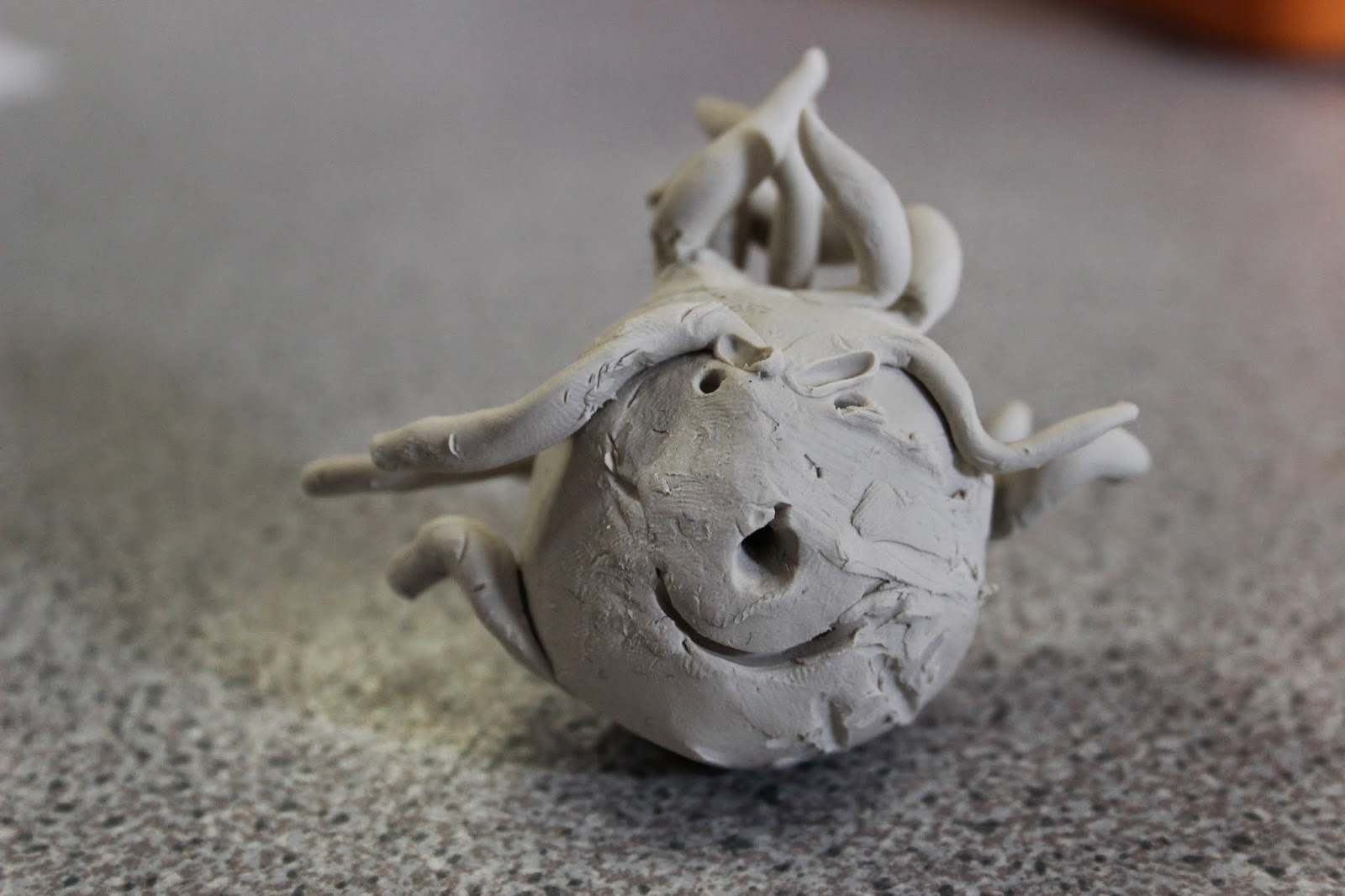
As part of the ongoing development of the methodology used in the Elements project, I have also designed sounds to inspire characters that represent the elements. I do this through something I call 'Sonic Moulding' – creating a three-dimensional model from sound. The diversity and imagination shown in this activity is stunning. Last year, I ran the project in four schools and not one model has been the same. It is an activity that both adults and children love.

The product of 'Sonic Moulding'
These models are then used as the basis for character descriptions. The engagement of the pupils is fantastic – they just love talking about their models, even giving them voices. Some pupils have even gone on to make short, stop-frame animation films with their models. There are so many possibilities.

The Elements project continues with sonic painting, drawing from sounds, poetry performance, expressive dance, song and sound design. Everything is put together for a special performance for parents and other invited guests. The pupils are encouraged to take an active role in all the preparations of this show. 

One parent said to me about his son in Year 4: ‘He usually doesn’t talk about school but this week he hasn’t stopped. He’s loved every minute.’

Try something like this yourself!

You will need:
  • An image of a door (either on screen, or printed - make sure if you print it to have enough to distribute among the pupils)
  • Two sounds of your choice
  • Paper/pens

Put the image of the door on the screen.

Tell the pupils that the first sound they will hear represents a setting behind the door. Ask the pupils (you can do this with any age – even adults love it!) to write down or draw what settings they ‘see’ behind the door. As sound affects us all differently, it is very possible that each individual will have many, unconnected ideas – this is fine and should be encouraged. 

One Year 1 class  used the sounds
to imagine a scary, cold cave
After the sound has been played, give the pupils a few minutes to gather their thoughts and then share the ideas. Get them to write down everything that comes into their heads and encourage as much detail as possible. Rather than saying ‘there is a forest behind the door’, ensure that the atmosphere, colours and all the small details are described. 

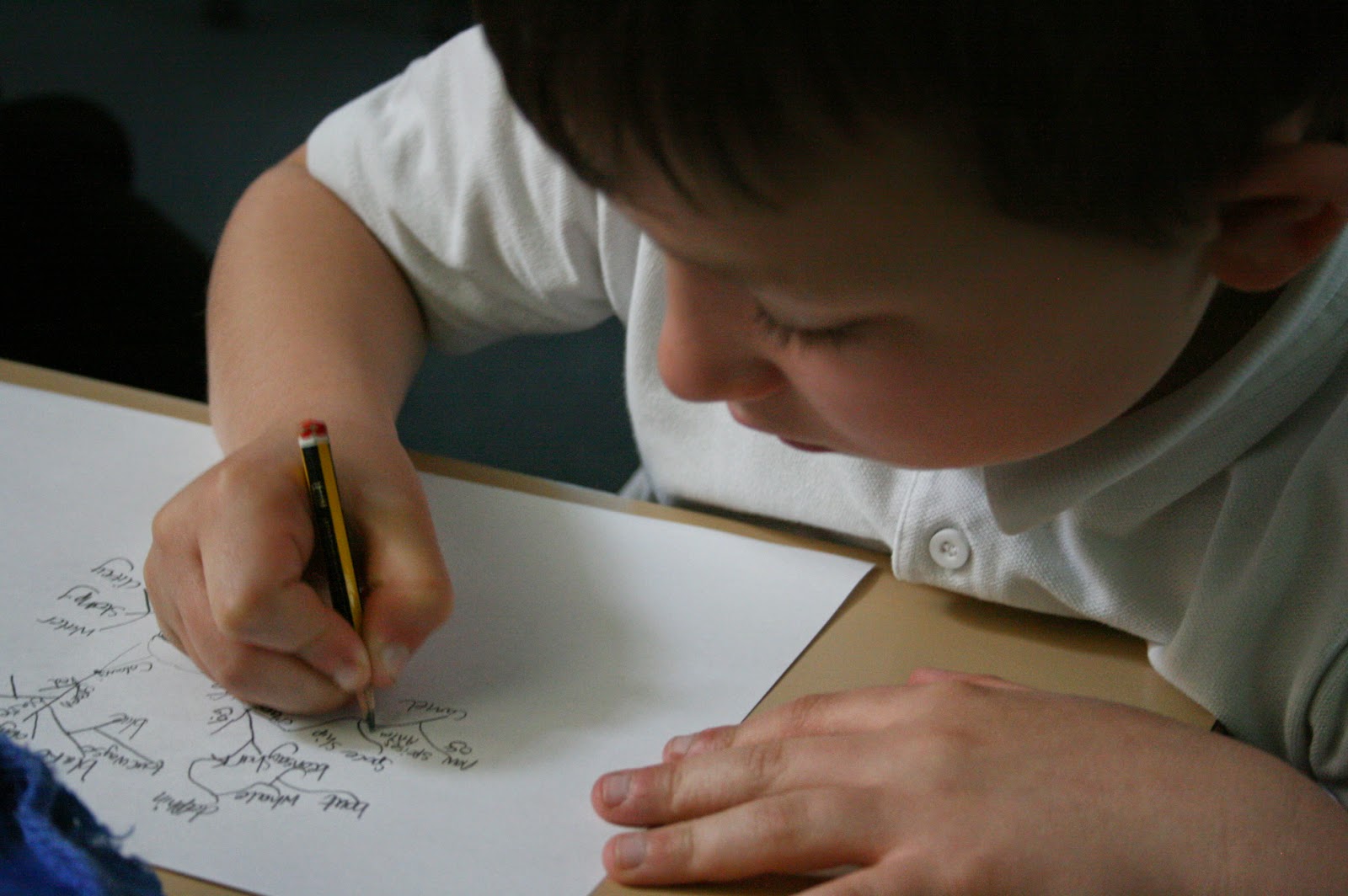
Students can jot down their ideas on mindmaps like the one to the right or post-it notes.

The second sound represents a character. It is important to mention here that you do not want your students to come up with a character from fiction, but an idea of their own. Students can base them on characters they know from fiction, but do encourage them to be original. It works.

Now your students have both a setting and a character - let the creative works commence!

This blog post has been adapted from the article Philip wrote for Creative Teaching and Learning magazine. You can purchase the fab full article here.

Find out more information about Philip and his work here.

Watch the video below to see some of the amazing creative responses generated during the Elements project.