Showing posts with label outdoor learning. Show all posts

Wednesday, 5 November 2014

Operation Playground - Free resources to stimulate active learning


Have your pupils create their own outdoor playground games with this series of free lesson plans from Canopies UK, all designed to encourage active learning and creative thinking skills. Then enter your children's best game into Canopies UK's national competition and stand to win a bespoke outdoor canopy for your school worth up to £10,000!


Research has shown that children respond better in the classroom when they are able to enjoy short bursts of exercise or take part in lessons that encourage active learning.

Active learning allows kids to think for themselves, work individually or in teams, engaging and challenging them to think about different situations enriching their learning. It can come in many varied ways, from collaborative activities to setting them tasks to do. It could even be just as simple as taking them away from the normal environment of the classroom and getting them moving around. This can provide many benefits for them, such as building key everyday skills like communication and teamwork, as well as helping to reinforce key messages or learning aims.

In an effort to encourage more active learning to be incorporated into lessons at a Key Stage 2 level, Darwen-based Canopies UK has launched an exciting new initiative - Operation Playground.


What is Operation Playground?

Operation Playground looks to combine both exercising with learning through five different activities, as well as spending more time outside, all within the realms of the national curriculum.

The project sees kids working together to come up with their own outdoor playground game, either based on a game that is played already, or one that is completely new. The only rules are that games must be:
  • safe to play
  • inclusive to all pupils
  • able to be played outdoors.
Youngsters often have vivid imaginations and so the concept allows them to put that to good use by thinking about how they can not only create games but how they can improve games they play already.

To facilitate this, five lesson plans with associated activities have been written for teachers or PE co-ordinators to use. All lesson plans have been tied to key subject areas and objectives that children are expected to learn as part of the curriculum this year. This not only balances the fun element in the classroom but also ensures that there is a clear, educational reason for taking part.


What are the benefits?

The initiative aims to deliver an accessible class project that gets pupils active and outside. From Physical Education to ICT, Operation Playground can be used in numerous different ways to increase knowledge and build many every day skills that are now fundamental growing up.

Communication is a major factor in the initiative not only verbally but also from a written perspective. Pupils not only contribute significantly in responding to questions asked by teachers but also by talking to their peers, valuing the contributions of each other. 

The lessons ask children to input throughout to build and develop their ideas in a positive manner. It tests their ability to listen carefully to instructions, as well as think about how instructions can be improved.

It is tailored to deliver a fun and enjoyable lesson that lets the pupils do the work and makes decisions themselves.

They are then expected to use their ideas to play the games and think about them further. By playing games, it encourages students to take part in physical activity, while also making them think about how they can incorporate movement and actions.

Schools who have already participated in the project, along with those currently in the process of creating their entry ahead of the closing date of 28th November, have expressed how enjoyable the activity was and currently is for their pupils.


Extra perks

Image: Canopies UK
Aside from the classroom benefit, each school that takes part and submits their best game entry created by the children will receive a certificate for their classroom for taking part. This will hopefully provide a sense of pride for those pupils whose game has been selected as the winning entry.

On top of this, those submissions will then be judged by a panel to win an outdoor play canopy for their school worth £10,000, which includes design, installation and manufacturing from Canopies UK. 

With this being an initiative the whole school can participate in, it can not only help to develop a friendly competitiveness within classes as they look to get the best entry. But it can also lead to healthy rivalry between schools as each one looks to be officially named the best game created.

This all sounds fun – how do I take part?

Schools wanting to take part can visit the Operation Playground page at the following link: www.canopiesuk.co.uk/education/playground/.

On this page, teachers can download the full teaching pack, which contains all the lesson plans and activities, as well as going into more detail on how to complete the entry.

There is also a map where you can see the schools in your local area that have already downloaded the pack and are taking part in the initiative.

Terms and conditions for entry are included in the teaching pack and the closing date for entries is the 28th November up to and including 11:59pm. 

For more information or to register to join (and download those free lesson plans!), visit: www.canopiesuk.co.uk/education/playground/.

Monday, 15 September 2014

Activities for outdoor learning this Autumn


Image: gardeningforkids.com.au

Earlier this year, we published a blog post detailing some lovely outdoor activities to enjoy with your students in the Spring time. But, in case you haven't noticed, it's no longer Spring! Autumn is upon us and with it brings plenty of opportunities to get your class out in the crisp golden sunshine and kicking about in the leaves.


The resource sheets, activity ideas and online flash games featured below are all available from The Woodland Trust's fabulous Nature Detectives website. They're all completely free so we figured they wouldn't mind us sharing some of their wonderful ideas and resources with our readers! Simply follow the links to download. And don't forget that this is just a sample. We really recommend checking out their site for more Autumn activities and ideas.

ID tools and spotter sheets
Some brilliant resources here! Get your class outside and identifying Autumn leaves, fruits and seeds, twigs and more. My personal favourite resource is the hunt for animal tracks, as well as - one for the boys this one - an animal poo ID sheet! (It does stress to kids that they shouldn't touch the animal droppings). Other spotter sheets include nocturnal animals, minibeasts, birds, bramble and fungi. If you don't have access to a proper woodland in school, why not send some spotter sheets home as homework (optional or otherwise)?


Image: Rake's School, West Sussex

Conkers
The best part of Autumn in my humble opinion... hunting for conkers! Nature Detectives provides instructions on how to play conkers, plus a snazzy conker champion certificate and a cool horse chestnut tree fact sheet. There's also a recipe for making realistic-looking conkers out of chocolate (no actual cooking required - all you need is a fridge) which would be great for a classroom session on cooking and nutrition.

Den building
Giving conkers a run for their money as most awesome Autumn activity, is this lovely set of tips for building a woodland den. It's aimed directly at the kids so it's all in really simple language with loads of great ideas plus helpful safety advice.

Tree faces
Image: naturedetectives.org.uk
A brilliant resource for art lessons this, students find and draw a picture/photograph a 'face' on a tree. It's a great way to develop imagination and also empathy, as the kids are encouraged to think about how the tree is feeling based on the face it's pulling. Could you take it one step further and have them come up with reasons why the tree is feeling that way? What happened in the woodlands that day? The children could write up their stories as a follow up activity or even look at existing stories about tree people, such as the green man or dryads from Greek mythology. Don't miss the tree face 'hall of fame' on the page linked above - your students could even send in their own 'tree face' photos like the one to the right.

Cross curricular indoor activities and online games
You don't even need to go outside to enjoy all Autumn has to offer in every subject across the curriculum! 

Science
Develop a range of scientific skills with this DIY fungus experiment in which kids control variables like temperature, moisture and light to work out what fungi need to grow best. Another science activity is the food chains game, a board game which teaches children the connections between woodland wildlife in a fun, imaginative way. 

Literacy
If you'd prefer to develop your class' literacy skills, why not try the concrete poetry online flash game. Kids choose a woodland shape (or draw their own) and fill it with words (either from pre-prepared word banks or their own imaginations) to make a poem. The completed poems can be printed out. 

Another literacy game on the Nature Detectives site is called Save our wood. This presents players with plans to build a road through beautiful Badger Wood. The player navigates the woodland, looking for woodland residents. They interview each creature, collecting information before designing and writing an article to defend the wood from development. There's also a list of supporting resources including a sheet to help them develop a balanced debate (with arguments both for and against), plus a template to help them format an offline newspaper piece too. 

History
Another fab online game worth mentioning, this one based around developing historical knowledge, is A tree's memory. In this game, kids meet three trees - the ancient tree, the city tree and the country tree. They pick a tree and fill in its life story from a choice of images. For example, the city tree is only 50 years old, but in 1969, it witnessed something that was 'out of this world'! After selecting the correct image, the player gets a bit more information on the event, plus the tree's opinion!


Image: Rake School, West Sussex
Are you thinking of taking your class outside? Fancy a bit more inspiration or some advice on assessing the risks? This article by The Woodland Trust's Amy Williams is packed full of safety advice and inventive ways to engage students with the natural world.

Alterntatively, if you'd prefer to read about other schools who've taken the plunge and rented a piece of woodland to care for and use with their students (and that's not as outrageous an idea as you might think), take a look at this article by Patricia Ockenden of woodlands.co.uk. In it, she describes the amazing curricular opportunities taking the classroom to the woods offers.

Tuesday, 29 April 2014

Outdoor ideas for springtime learning


The birds are singing, the buds are blooming, the sun is shining and the sky is blue... well, mostly, we are in Britain after all! 

The point is spring has sprung and come rain or shine (and admittedly, it is mostly rain), there are plenty of opportunities to get your class outside and enjoying the fresh air.

But what to do? Even just teaching your normal curriculum outdoors is a start, but if you're looking for some real outdoorsy activities and you're not afraid of a little bit of mud, then the Woodland Trust's Nature Detectives website is a great place to start.

It offers over a thousand nature-based activities available for families, children and teachers to download completely free. Each resource provides hours of fun that incorporates learning, nature and creativity, and can be adapted to suit children of all ages. 

Here are some great ideas from the site's Spring section:

Adventures with sticks – From twig towers to stick ships, magic wands to winter wreaths, there are tons of things you can do with sticks. This resource pack gives some ideas to get you started.

Welly wander – A set of activity sheets to accompany a walk in wellies! What do you paddle in, wade through, jump in, splash...? What do you see, smell, hear and feel on your welly wander? 

Weather diary – A brilliant template to record the changing weather. Helps you track sunshine, temperature, rainfall, wind speed and cloudiness.

Tree identification tools – Identify trees from their twigs, leaves, buds and blossom. Plus a whole load of fun games, puzzles and craft activities related to trees. 

Spring symphony – Listen to the sounds of spring, then make your own with natural materials.

Colour bingo – How many colours can you spot in nature?

What have you spotted? – Springtime scavenger hunt. Includes frog spawn, butterflies, catkins, blossom and more.

Hunt for animal tracks – Hunt for and identify animal tracks left in the mud or snow! Includes Badger, deer, dog, duck, fox, heron, otter and squirrel.

Bird Pack – 25 free printable activity sheets, plus videos and desktop wallpapers to get children excited about bird life. Includes a bird spotter sheet, bird bingo, a balancing swallow to colour in and perch somewhere interesting, and the nest building challenge – a hands on activity to help children learn how birds build their nests. 

Pirate Pack – Help your class make themselves a pirate hat, then set sail for the woods. They can build a stick ship, make a treasure chest, then start hunting for natural treasures. 

The Woodland Trust regularly updates the resources on its Nature Detectives website, so keep an eye out for new and exciting ways to encourage children and young people to interact with nature, especially as we move into the summer.

< Read the previous post in this series

The material in this series of blog posts is taken from the article 'A practical guide to outdoor learning' by Amy Williams of The Woodland Trust.


Have you enjoyed this series? Tell us what you think!

Wednesday, 23 April 2014

How to reduce risk when teaching outdoors


Intrepid, excitable students, mud, nettles, bugs, rivers, dogs and trees so tall you just have to climb them can sound like a scary combination. 

In fact, the risks involved with teaching your students in the wild woodlands can sound so scary, you could be tempted to lock the classroom windows, close the blinds and stay inside where it's safe and you can't get sued by angry parents...

Of course, taking a group of students outside will always involve a certain degree of 'risk'. But assessing these risks beforehand and taking action to avoid them can put your mind at ease and contribute to a healthier, happier experience for students.

The table below outlines some of the more common risks associated with the outdoors - but it's not comprehensive. You should definitely assess your own outdoor sites in accordance with your school's risk assessment procedures and apply risk levels.

But don't wrap your students up in cotton wool! Kids need to encounter some form of risk in order to develop the important problem-solving skills they'll need when they encounter risks later on in life.


Hazard                                     Action


Sharp or prickly materials
Encourage long sleeves and sturdy footwear (not sandals) and discourage wearing shorts. Carry a First Aid kit.

Poisonous berries/fungi

Give verbal warnings not to eat anything or put things/fingers in their mouths. Seek medical assistance if ingested. Wash hands carefully after the trip (especially before eating or drinking) or carry wet-wipes or antibacterial gel.

Low branches

Give verbal warnings to take care (especially of eyes).

Uneven ground, holes, slopes, fallen branches

Advise to walk carefully. Wear suitable footwear and plan a route appropriate to the weather.

Children going out of sight/missing

Advise children on boundaries and give verbal warnings. Adults to keep visual contact with their group.  Make sure you have the correct ratio of adults: students.
Have an agreed ‘missing person’ procedure that everyone is aware of, including an agreed meeting point in emergency situations.

General public

Avoid contact with strangers and animals where possible. Ask owners to control their animals if passing.

Insect bites/stings or allergies

Be aware of children with allergies (such as nuts, insect stings, hay fever). Check anyone with severe allergies has their asthma pump or EpiPen, and they are able to administer it. Remind everyone of the risk. Carry a First Aid kit.

Dangerous Litter (for example, fly-tipped waste, broken glass, syringes and so on)

Conduct safety sweep of area before activity takes place. Remind people of dangers and if appropriate, show an example.

Disease or infection– for example, Toxicara canis (from dog faeces), Leptospirosis (from rat urine in water), Tetanus (from soil), or Lyme Disease (from ticks)

Cover broken skin on hands (for example wear gloves or use plasters), advise of risks and symptoms, and seek medical advice as soon as possible if infection is suspected.
Tuck socks into trousers if in potential tick area.

Sun/ultra-violet radiation

Advise of risks. Cover exposed skin, especially top of the head, back of the neck and shoulders. Work in the shade where possible.

Slippery surfaces

Warn about mud or ice. Change activity or route according to the weather. Wear appropriate footwear.

Electrical storms or gale force winds

Check weather websites for the latest information and severe weather warnings. Cancel activity if too severe.

Open water


Give a verbal warning of danger area. Advise to keep clear of water’s edge and banks.
Have a throw line handy if working near deep or fast flowing water.


Look out for the next blog post in this series, which will offer a number of inventive ways to engage students with the natural world, this spring and beyond.

< Read the previous post in the series                       Read the next post in this series>

The material in this series of blog posts is taken from the article 'A practical guide to outdoor learning' by Amy Williams of The Woodland Trust. 

Wednesday, 16 April 2014

10 ways to make outdoor teaching easier


Taking learning outdoors can sometimes prove quite stressful for a teacher. There's so much to think about beforehand - what to take, what to wear - and what about when you get there? The wild and wonderful world of the woods is just so distracting for students... why would they bother listening to you when there's so much to explore?

But there are a number of things you can do to make teaching outdoors easier! And they're actually really really simple.

To get you started, here are ten ways you can keep your students safe and their attention firmly focused on you – all the while making sure you're giving them the best and most enjoyable outdoor experience you can.


  1. Set expectations before going out – Understanding what is going to happen and how long it will take will help children relax. Keep it positive and emphasise ‘care’ through looking after themselves, each other and the natural environment.
  2. Take a rucksack for necessities – This would include a first aid kit, water, mobile phone, emergency contact details, hazard tick list, sit-mats, whistles – a gentle sounding one to call the group back together (i.e. owl hoot or ocarina) and a sharp-sounding emergency one. Don’t forget any evaluation equipment you plan on using – for example, a camera (and spare batteries) or post-it notes. And if carrying props for any activities, pack them in order of use to make your life easier.
  3. Appropriate clothing – Ensure children are wearing appropriate clothing and footwear. Suggest zipping up/tucking in/putting on hats before they start getting too cold (or hot).
  4. Be sensitive to fears/preconceptions – Children may feel woods are dangerous (thanks to many nursery rhymes and fairy tales, as well as negative media stories). If these arise, try to deal with them in an understanding and non-judgemental way.
  5. Keep it simple – Children find it hard to listen to someone talking for too long, especially outdoors. Have a clear mental plan of the session before you go out.
  6. Go visual, auditory and kinaesthetic – Engage everyone by trying to have a visual focal point (for example, stand near or hold the thing you are talking about) and if you can, demonstrate it too.
  7. Circle-up – Get the whole group, including adults, into a circle when introducing and ending activities, as this means you will have everyone’s attention and hopefully only have to say things once. Invent different ways to do this to make it fun (i.e. ‘sticking’ elbows, knees or toes to neighbours).
  8. Weather affects ability to learn – Try to stand facing the sun when talking to your
    group so they won’t have to squint. Attention span decreases in windy, wet or cold weather so adjust your expectations accordingly.
  9. Meeting dogs off the lead – Ask children to fold their arms and look away from dogs if you meet them off the lead. The dog should quickly get bored and leave.
  10. Evaluate outside – Sharing the learning experience while still outside will provide more valuable feedback because it is done in context.


Look out for the next blog post in this series!
Of course, taking a group of students outside involves a certain degree of risk. The third post in this series will feature a hazard tick list which will outline a number of the hazards you may encounter while outdoors and what you can do to avoid them.

The material in this series of blog posts is taken from the article 'A practical guide to outdoor learning' by Amy Williams of The Woodland Trust.

Tuesday, 8 April 2014

5 ways to start your outdoor learning journey


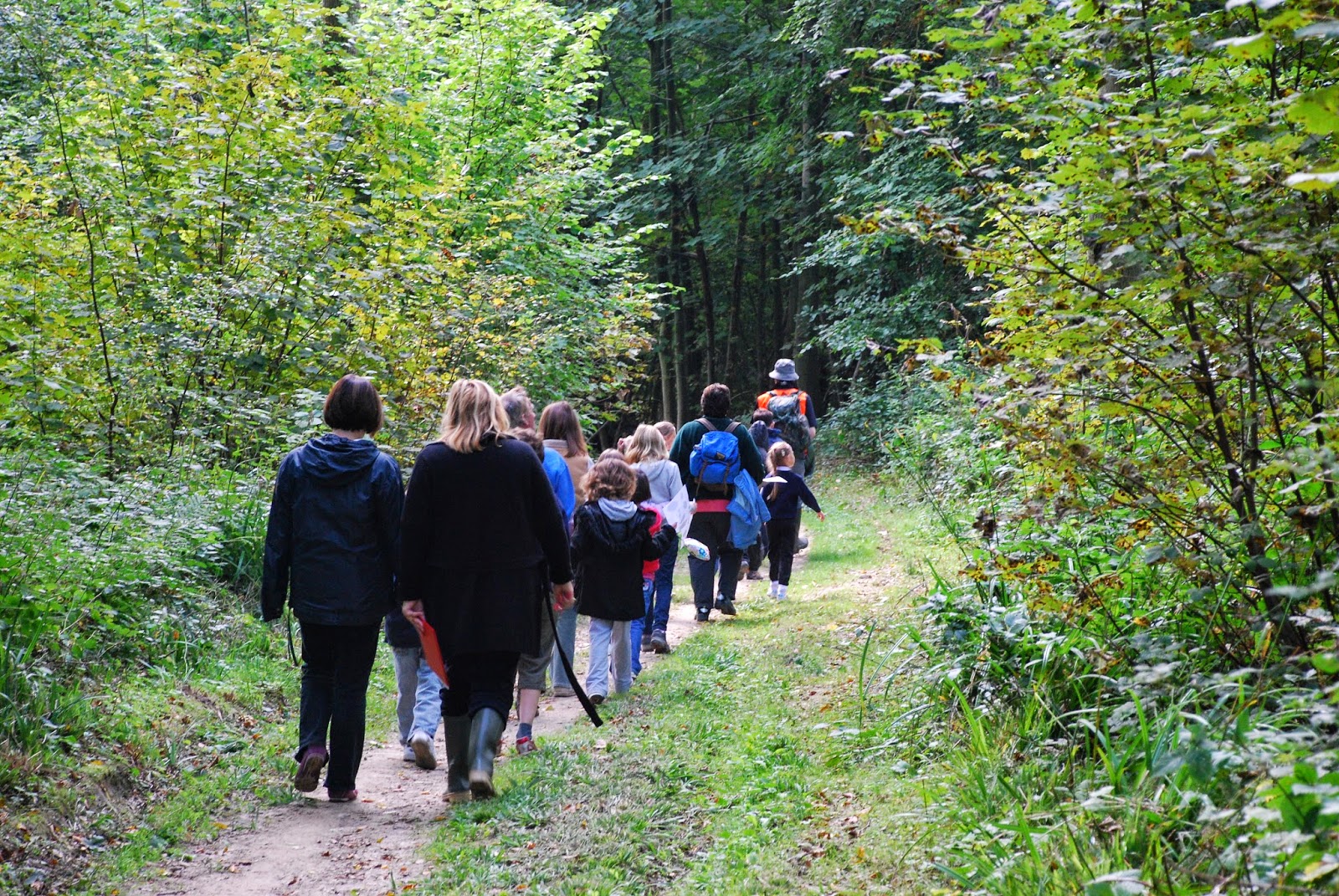
Off to the woods we go!
(Photo: The Woodland Trust)
I'm sure that if I were to ask you what your favourite playtime activities were when you were little, many of you would reply with climbing trees, splashing in puddles, 'baking' mud pies, mixing plant potions and more. My mum was always trying to bring me in the house, but all I wanted to do was to play outside - no matter the weather!

These days, however, kids often don't get the opportunities to enjoy the great outdoors. According to the RSPB, only 21 per cent of eight to 12-year-olds currently living in the UK have a discernible connection with nature. Children need to learn about, value and understand nature so they are inspired to care for it from an early age. The younger a child experiences contact with nature such as planting a tree or walking through woodland, the closer their connection with the environment will be as they grow into adulthood.

Teachers and school staff are in a prime position to connect children and young people with nature and prepare them for their role as future guardians of the environment – but how can they do so?

This post marks the start of a four-part series on outdoor learning, in which we will provide you with some helpful advice on taking learning outdoors and offer a number of inventive ways to engage students with the natural world, this spring and beyond.

What is outdoor learning?
Outdoor learning is, quite simply, organised learning that takes place in the outdoors. 

Contrary to popular belief, it doesn't have to be dangerous, expensive or out of your comfort zone. Although the overarching label ‘outdoor learning’ can include adventurous pursuits such as hiking, climbing and kayaking, it can purely be about taking your normal, everyday curriculum and bringing it to life by teaching outside.

Getting started
First of all you have to choose where to go! This doesn't have to be a far away spot, it can be close to the school and within walking distance - it can be the school grounds, a local park, even a nearby patch of woodland. 

To find the nearest space for outdoor learning, you can go to www.visitwoods.org.uk and simply search using your postcode.

5 ways to get kids excited about a day in the woods
Learning is a journey. You can stimulate interest, intrigue and imagination in your new outdoor learning topic from the start by using varied approaches to introducing it. 

Here are some simple but inventive ways to start your outdoor learning journey:
  1. Surprise invitation or parcel – Send an invitation letter (or email) to the class asking them to visit their local woodland or asking for their help to investigate an environmental issue. Arrange for a surprise package to be delivered, addressed to the class. Fill it with items that will spark discussion about the new topic.
  2. Share a story – Find a good story that illustrates the topic and gives you an opportunity to talk around the subject with your class before going outdoors. The children could bring sections of it to life for one another using natural materials to stimulate the senses – or even write their own story to share.
  3. Fictional characters – Bringing in a recognisable toy from a relevant book can provide a great stimulus for your outdoor topic. For example, an Eeyore (or even a home-made ‘Stickman’!) with a Paddington-style ‘Please look after this...’ label. Children in one class in a primary school in West Lothian arrived one morning to find a paper trail of animal tracks leading into the classroom. At the end of them, a toy fox and its cub were sitting in the centre of the floor with a letter next to them. The letter explained how the foxes’ home – the enchanted woodland – had been destroyed and so they no longer had anywhere to live. It asked the children if they could help the foxes create a new home.
  4. Interesting maps – Create a map of your local woodland area stylised to look like a very old map, a treasure map or one found in a book that is familiar to the children –from Winnie the Pooh, for example. Use intriguingly enigmatic names for features they will find there (old trees, hills, mossy stumps and so on) and clues as to what they might do in particular spots. Hang it on the classroom wall for a week or two before visiting the outdoor area to help build a sense of expectation and excitement.
  5. Mysterious photographs – Arrange for the children to arrive back after break to find the room darkened and a slideshow of photographs showing familiar local places taken from unusual angles. Play some suitable music or woodland sounds to create a calm atmosphere. This will increase anticipation for their woodland walk, but will also get the children focused on trying to guess exactly where the photos were taken.
There's such a thing as too excited... 
(Photo: The Woodland Trust)
Follow our blog for more inspiration and helpful advice on planning the perfect outdoor activities. Our next instalment of this series will provide a number of strategies for making teaching outside easier and more enjoyable.


The material in this series of articles is taken from the article 'A practical guide to outdoor learning' by Amy Williams of The Woodland Trust.