Tuesday, 8 April 2014

5 ways to start your outdoor learning journey


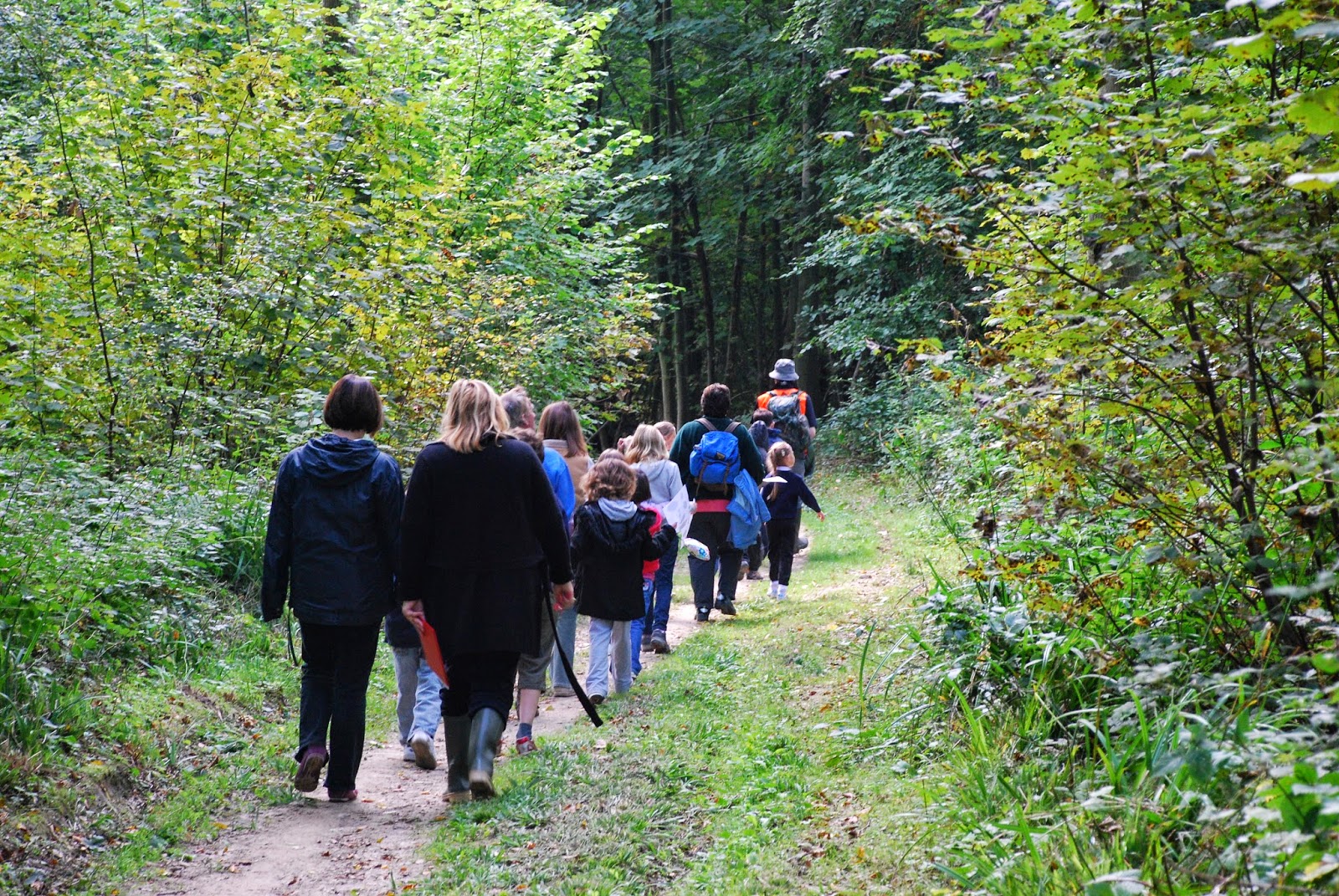
Off to the woods we go!
(Photo: The Woodland Trust)
I'm sure that if I were to ask you what your favourite playtime activities were when you were little, many of you would reply with climbing trees, splashing in puddles, 'baking' mud pies, mixing plant potions and more. My mum was always trying to bring me in the house, but all I wanted to do was to play outside - no matter the weather!

These days, however, kids often don't get the opportunities to enjoy the great outdoors. According to the RSPB, only 21 per cent of eight to 12-year-olds currently living in the UK have a discernible connection with nature. Children need to learn about, value and understand nature so they are inspired to care for it from an early age. The younger a child experiences contact with nature such as planting a tree or walking through woodland, the closer their connection with the environment will be as they grow into adulthood.

Teachers and school staff are in a prime position to connect children and young people with nature and prepare them for their role as future guardians of the environment – but how can they do so?

This post marks the start of a four-part series on outdoor learning, in which we will provide you with some helpful advice on taking learning outdoors and offer a number of inventive ways to engage students with the natural world, this spring and beyond.

What is outdoor learning?
Outdoor learning is, quite simply, organised learning that takes place in the outdoors. 

Contrary to popular belief, it doesn't have to be dangerous, expensive or out of your comfort zone. Although the overarching label ‘outdoor learning’ can include adventurous pursuits such as hiking, climbing and kayaking, it can purely be about taking your normal, everyday curriculum and bringing it to life by teaching outside.

Getting started
First of all you have to choose where to go! This doesn't have to be a far away spot, it can be close to the school and within walking distance - it can be the school grounds, a local park, even a nearby patch of woodland. 

To find the nearest space for outdoor learning, you can go to www.visitwoods.org.uk and simply search using your postcode.

5 ways to get kids excited about a day in the woods
Learning is a journey. You can stimulate interest, intrigue and imagination in your new outdoor learning topic from the start by using varied approaches to introducing it. 

Here are some simple but inventive ways to start your outdoor learning journey:
  1. Surprise invitation or parcel – Send an invitation letter (or email) to the class asking them to visit their local woodland or asking for their help to investigate an environmental issue. Arrange for a surprise package to be delivered, addressed to the class. Fill it with items that will spark discussion about the new topic.
  2. Share a story – Find a good story that illustrates the topic and gives you an opportunity to talk around the subject with your class before going outdoors. The children could bring sections of it to life for one another using natural materials to stimulate the senses – or even write their own story to share.
  3. Fictional characters – Bringing in a recognisable toy from a relevant book can provide a great stimulus for your outdoor topic. For example, an Eeyore (or even a home-made ‘Stickman’!) with a Paddington-style ‘Please look after this...’ label. Children in one class in a primary school in West Lothian arrived one morning to find a paper trail of animal tracks leading into the classroom. At the end of them, a toy fox and its cub were sitting in the centre of the floor with a letter next to them. The letter explained how the foxes’ home – the enchanted woodland – had been destroyed and so they no longer had anywhere to live. It asked the children if they could help the foxes create a new home.
  4. Interesting maps – Create a map of your local woodland area stylised to look like a very old map, a treasure map or one found in a book that is familiar to the children –from Winnie the Pooh, for example. Use intriguingly enigmatic names for features they will find there (old trees, hills, mossy stumps and so on) and clues as to what they might do in particular spots. Hang it on the classroom wall for a week or two before visiting the outdoor area to help build a sense of expectation and excitement.
  5. Mysterious photographs – Arrange for the children to arrive back after break to find the room darkened and a slideshow of photographs showing familiar local places taken from unusual angles. Play some suitable music or woodland sounds to create a calm atmosphere. This will increase anticipation for their woodland walk, but will also get the children focused on trying to guess exactly where the photos were taken.
There's such a thing as too excited... 
(Photo: The Woodland Trust)
Follow our blog for more inspiration and helpful advice on planning the perfect outdoor activities. Our next instalment of this series will provide a number of strategies for making teaching outside easier and more enjoyable.


The material in this series of articles is taken from the article 'A practical guide to outdoor learning' by Amy Williams of The Woodland Trust.

Tuesday, 25 March 2014

Would Prof. Brian Cox rather be Neil Armstrong or Yuri Gagarin?


Prof. Cox at the Education Show
Both apparently, if his interview at this year’s Education Show was anything to go by. 

We were lucky enough to nab a great spot (though unfortunately, not a seat – the theatre was rammed) for the famous physicist’s discussion on making science accessible and exciting. Maisie Gould reports on the highlights of his half-hour interview.


An unexpectedly charismatic man, Brian Cox chatted with chairperson, Charles Clarke, about his own experiences in school, his fleeting career as a pop star, and how he tries to get his five-year-old son to talk with him about anything he’s interested in – whether that be astrophysics or conkers! 

Cox also spoke about his upcoming TV series which he has only just finished filming – in fact, only the day before his interview here in Birmingham, he’d been astronaut training at the Yuri Gagarin Cosmonaut Training Centre in Star City, Russia. At the training centre, they use full sized mock ups of all major spacecraft developed since the Soviet era submerged in the centre’s massive pool (Brian said it was about the size of the NEC’s exhibition hall where the Education Show was held) to train cosmonauts. Apparently, they’d got Brian in an astronaut’s suit and had him training underwater with a mock up of the International Space Station.

Brian in his space suit. 
(Photo: apolloschildren.com)
“I thought I was really good… really calm and relaxed,” Brian said. “But when I got out, the doctor monitoring me came over and said ‘You really shouldn't be doing that at your age – your ECG was all over the place’, so apparently, I was really stressed and nervous!”

Brian also had the huge privilege of witnessing the Soyuz landing while in Kazakhstan. He and his film crew were actually the first on scene: “It was crazy – the capsule’s really tiny. We just stood there, thinking there’s three guys in there, and what if no one turns up to get them out? Luckily, a few minutes later, a helicopter turned up.”

“They got out a stepladder and literally dragged them out of the capsule and put them in deck chairs!” Brian said with a laugh. “These guys had been on the space station for six months so they couldn't move at all. You've been in space for months, and then when you come home, you’re just dumped on deckchairs in the snow!” 

The Soyuz crew in their deck chairs! 
(Photo: space.com)
The Soyuz landing and Brian’s astronaut training will all be shown in his upcoming series, ‘The Human Universe’, which focuses on our value as humans. A long time ago, people thought we were the centre of the universe – over time, as our scientific knowledge advanced and we discovered just how large the universe is, we realised actually, we’re quite irrelevant in the grand scheme of things. Or are we?

“We believe there are billions of planets in the universe which can sustain life, but advanced civilisations are actually very rare,” Brian explained. Maybe we're a lot more significant than we thought!

Aside from entertaining us with anecdotes, the famous physicist also found time to talk about science in schools. Speaking about the students he teaches, Brian Cox said it's their responsibility to ensure they understand what they're learning. “They come to me saying ‘I'm sorry, I haven’t finished this paper’, and I'm like I don’t care whether you've done it or not. Actually, I'm glad you haven’t done it because then I don’t have to mark it!” 

In all seriousness though, when asked via Twitter about the current content-driven agenda for schools, Brian explained that he wants his students to develop as researchers – and it’s easier for them to do that if they are able to take responsibility for their own learning and have learned how to do this at school. 

He added:“The process of understanding something is where the excitement lies and you will never forget it when you go through that – it’s taking delight and responsibility for your own understanding.”

During the question-and-answer session that followed his interview, the professor reflected on how to get more students interested in science – especially girls. "We are leaving a whole cohort of talent out of this part of the economy by not having enough of them," he said, before adding: “There is a lot of research on this – one bit says we should teach [girls] on their own without boys,” he said. “Whether it is politically palatable I don’t know, but girls do better in all girl classes, not necessarily in all girls schools.”

Brian also proposed an interesting idea – he said he would like more universities to bring teachers in to use their facilities and share academic findings to take back to the classroom. “I’d like to do that myself,” he added. He also said he thinks academics should help teachers have the knowledge to talk about new scientific discoveries in schools, as saying ‘we just discovered this last Monday’ is a great way to get kids excited about science – “It’s new and it’s happening right now,” Brian stressed.

Brian also suggested linking science to things students already find exciting, like the television series, Doctor Who: "You can teach time dilation and the fact moving clocks run slowly. In fact, I did it in my BBC Lecture, ‘The Science of Doctor Who’ – so the fact you can do it on television, which is significantly dumbed down, means you can do it at A-Level physics."

To finish, a local primary school teacher whose Year 2 class is currently studying Neil Armstrong and the moon landing, asked whether the professor would rather have been the first man on the moon, or Yuri Gagarin, the first man in space. 

After much deliberation, Cox decided both would have been equally exciting. He did, however, add that he didn’t think he could have done what Yuri Gagarin did – cram himself into a tiny metal capsule and head off into the great unknown, with no idea what would happen. “I have utmost respect for the man,” Brian said.

And we, you, Professor. In fact, we'd have very much liked to tell him in person (and perhaps get a sneaky pic), if it hadn't have been for the burly security guards steering the famous physicist through his sea of fan girls.

Honestly... you'd have thought Professor Brian Cox was a pop star!


If you missed Brian's interview at the Education Show, you can read an edited version here.

Wednesday, 12 March 2014

How afterschool film clubs encourage thinking


And the best thing about 3D films?
Those funky glasses. 
(Image: filmclub.org)

Film clubs provide young people with a rare opportunity to be part of something fun, creative and sociable. Sabrina Broadbent reports on an exciting initiative to give more children the chance to get involved.

Ask anyone over the age of 40 if they had a film club at school, and the chances are they will tell you that they did and it’ll be hard to stop them telling you what they saw. They’ll remember the teacher, the magic of having a familiar space transformed into a screening event, and they’ll always remember the film.

Sadly, those film clubs in the 60s and 70s rarely lasted long - sourcing the film reels was difficult and expensive, lacing up the projector was complicated, sound systems were unreliable and the teacher usually worked alone without support or encouragement. Nevertheless, the films that were screened remain as memorable events in the minds of the young people who saw them.

What is a film club?
A film club, like a reading group, is an intimate and informal gathering where people can encounter ideas, experiences and emotions that may not be everyday topics of discussion but which shape all our lives.

Film is a vast vault of stories stretching back one hundred years, across every continent and told in every language. It is an extraordinary cultural asset, yet British children see practically nothing of it. The theatrical releases represent a tiny and culturally skewed percentage of this archive of creative and intellectual endeavour.

Since its roll out in Spring 2008, FILMCLUB has curated and made available thousands of films to state schools. The idea behind FILMCLUB, brainchild of film director, Beeban Kidron and educationalist, Lindsay Mackie, was to give every child the chance to watch one film a week, free of charge, from beginning to end, with a chance to talk about it afterwards.

Now that both the technology and distribution methods are at a point where a model film club could be reproduced in as many schools in the country that wanted one, Kidron and Mackie decided the time was right for school film clubs to become a government-funded entitlement for all school children.

There are now over 7000 film clubs across all four nations of the UK, reaching over 200,000 children and young people every week. Based on a general survey with film club leaders on the impact of FILMCLUB, teachers report that the educational and social benefits to the children attending are considerable. 81 per cent say it develops children’s critical reasoning skills, 80 per cent say it makes children more positive about school and 81 per cent say that it integrates isolated or disengaged children.

An opportunity to be a part of something
Cinema, like theatre, was originally a social act – a collective spectatorship of a story played out upon a stage or screen. Sitting together, but apart, in the darkness and the warmth was integral to the experience. Many people experience film quite differently now and viewing is often an isolated act – on computers and phones. FILMCLUB is changing that.

‘A lot of the disaffected kids are smiling – you don’t often see those children smile,’ observed one teacher from a secondary school in Hastings.

A film club is one way that a school can help children to feel a part of something, not apart from everything. Inclusion is a central aim of many teachers’ film clubs, and headteachers are quick to see that a film club can make children more emotionally receptive to learning.

A film club audience is a unique, self-selecting group of children. It’s unusual to find a grouping quite like it at any other time or place in the school day. It cuts across age, class, ability, gender and ethnic boundaries and it is often a magnet for curious, shy and unusual minds who find their way each week to sit in the dark to watch what film writer, David Thompson, calls ‘the frenzy on the wall’ – who linger afterwards to listen and share their thoughts on films as diverse as Wall-E, Spirited Away, Madagascar, Shaolin Soccer, Mad Hot Ballroom and The Story of the Weeping Camel.


Tuesday, 26 November 2013

The differences between projects and project-based learning


There are many differences between 'doing' projects and taking a project-based learning (PBL) approach. But what are they? 

The chart below by Amy Mayer of friEdTechnology is helpful to clarify the important differences between projects and project-based learning – the main difference being the process itself. As you can see, this view of projects vs. project-based learning is slanted in favour of PBL, but it’s interesting nonetheless. 

You can also download the table as a printable word document here.


Projects…
Project-based learning…
Can be done at home without teacher guidance or team collaboration.
Requires teacher guidance and team collaboration.
Can be outlined in detail on one piece of paper by the teacher.
Includes many ‘Need to Knows’* on the part of the students and teachers.
Are used year after year and usually focus on product (make a mobile, a poster, a diorama, etc.).
Is timely, complex, covers many TEKS**, and takes a team of highly trained professionals significant time to plan and implement.
The teacher work occurs mainly after the project is complete.
The teacher work occurs mainly before the project starts.
The students do not have many opportunities to make choices at any point in the project.
The students make most of the choices during the project within the pre-approved guidelines. The teacher is often surprised and even delighted with the students’ choices.
Are based upon directions and are done ‘like last year’.
Is based upon driving questions that encompass every aspect of the learning that will occur and establishes the need to know.
Are often graded based on teacher perceptions that may or may not be explicitly shared with students, like neatness.
Is graded based on a clearly defined rubric made or modified specifically for the project.
Are closed: every project has the same goal.
Is open: students make choices that determine the outcome and path of the research.
Cannot be used in the real world to solve real problems.
Could provide solutions in the real world to real problems even though they may not be implemented.
Are not particularly relevant to students’ lives.
Is relevant to students’ lives or future lives.
Do not resemble work done in the real world.
Is just like or closely resembles work done in the real world.
Do not include scenarios and background information or are based on events that have already been resolved.
The scenario or simulation is real or if it is fictitious, is realistic, entertaining, and timely.
Are sometimes based around a tool for the sake of the tool rather than of an authentic question. (Make a Prezi.)
Use technology, tools, and practices of the real world work environment purposefully. Students choose tools according to purposes.
Happen after the ‘real’ learning has already occurred and are just the ‘dessert’.
Is how students do the real learning.
Are turned in.
Is presented to a public audience encompassing people from outside the classroom.
Are all the same.
Is different.
Example:
Make a model (or diorama or mobile) of the school/town/local site of interest.
Example:
Design a fortification that would take your community through a bio or other non-traditional attack and make a recommendation to the city council for future planning.
 © Amy Mayer, @friEdTechnology, The Original WOW! Academy www.friEdTechnology.com. Please copy and use freely!

* ‘Need to knows’ – things that will need to be learned or discovered during the process of creating the product.

** Texas Essential Knowledge and Skills (TEKS) – the state standards for what students should know and be able to do. The Texan equivalent of the National Curriculum or Common Core Standards.